Sunday, February 24, 2013

Bauhaus,part two

Another charismatic and progressive thinking person who taught at Bauhaus was Oskar Schlemmer. The subject which he loved to explore was the proportional perfection of a human body and the things humans are capable of doing with it. His theater workshop at Bauhaus was one of the places where abstraction in dance had been explored for the first time.

Oskar Schlemmer's Stick Dance, 1927. via Retronaut

Reconstruction of Stick Dance at the Centro Universitario SENAC,
São Paulo, Brazil., 2010. via Flickriver

Oskar Schlemmer's love for geometry, mathematics, abstraction and purity of form can be seen so clearly in his Stäbetanz  (Stick Dance). In a motionless position, lines-sticks, as the extensions of a human body, resemble the abstract painting. And as the dance starts and lines start moving, the painting itself starts to dance.

A wonderful reconstruction of this piece was conducted by an art teacher, designer and dancer Isaura da Cunha Seppi, at the Centro Universitario SENAC in São Paulo, Brazil. This was actually a part of a much bigger project conducted from 2008. until 2010. in which not only Stick Dance has been reconstructed, but also Schlemmer's famous Das Triadisches Ballett.


This video is a mixture of two realities, Real and Second life of  the Stick Dance by Oskar Schlemmer. Isaura da Cunha Seppi mixed the video of her real-life performance with machinima which was created using the Second Life in order to explore the idea of boundaries between the real and virtual world narrowing down more and more nowadays.

Saturday, February 16, 2013

Bauhaus, part one

Where to start when you wish to talk about Bauhaus?

I think I'll start with stunning food photography inspired by Bauhaus, which I stumbled upon some time ago. Masterminds behind these pieces: Nicky&Max.

© Nicky & Max
© Nicky & Max

Bauhaus was not just a movement, but an actual institution as well. Walter Gropius had gathered some of that time's brightest minds around him, such as Paul Klee, Wassily Kandinsky, Herbert Bayer, Oskar Schlemmer, Johannes Itten, and founded the Bauhaus School in 1919. All of them stood for strong individuals which was one of the fundamental things behind school's ideology: unlocking the creative potential of each student through insisting on individualism, on one hand and collaborative work, on the other. 


© Erich Consemüller, Lis Beyer or Ise Gropius sitting on the B3 club chair by Marcel Breuer and wearing a mask by Oskar Schlemmer and dress fabric by Lis Beyer, c.1927

What I find interesting is the way the school had operated in its early days.The school had always been trying to make a compromise between utopian, non-compromising, creative spirit and practical minded way of thinking. And it seems to me that in the first years the school leaned more towards the former and from. 1923. under the pressure of community and financial troubles it started leaning towards latter.

Johannes Itten was to me one of the most intriguing professors at Bauhaus. He held an innovative course which taught the students about basics of materials, composition and color. Itten was a fanatic follower of Mazdaznan, a religious health movement which included strict food diets. He incorporated some of Mazdaznan's exercises and breathing techniques into classes in order for students to use their full creative power. He also made rules about food which was to be consumed at school. No meat was allowed, only grains and vegetables, with special emphasis on garlic. The word is that at some point in time all school's facilities and students (!) had that distinctive garlic smell.

 Itten's class, via Kaufmann Mercantile

I love this photo. It gives you a glimpse of working atmosphere in Itten's class. I wonder if that food diet just might had an effect on student's work because at this time they were producing some incredible ideas and creating the most astonishing art pieces.

However, Itten's and Gropius's ideologies started to distinctively drift away from each other. Gropius was insisting on individual art being made with thoughts for the outside world or the industry and Itten rejected this and insisted on art being created without thoughts of its mass production. Finally, Gropius made Itten resign and from this point on, the School made its ideological change in favor of producing art in cooperation with the industry.

While in process of making those photos from the beginning of this post, Nicki&Max were aware of the fact they were being made for no one, they had no commercial value or as they say, they were making them just for themselves.  And they admit, they felt much more creative than when working for a client and they finally felt like they were using their full creative power.

Sunday, January 27, 2013

Moog.

via Retro Synth Ads

I love this ad. Simple, smart and brave. It should be emphasized that the ad is from 1979. Shot of the company's product from behind, no logo, no contact info, no nothing, just a small Moog symbol incorporated into the ad's copy. Not many companies can pull this off, not even today. But Moog could. You really had to and have to know what this is.

via Retro Synth Ads

For anyone who hasn't seen the inspirational documentary about the inventor of Moog synthesizers, Mr. Robert Moog, quick, here it is.

One of the people who had been among first musicians to start using Moog synthesizers, was the contemporary German composer, Gershon Kingsley. Many don't know that he is the composer of the famous instrumental "Popcorn". A great tribute to the song was given by the Muppets in one of the most wonderful sketches ever (someone special with very busy nails discovered this one):


Fast forwarding to nowadays, Moog company is about to start selling their new analog synth - the Sub-Phatty, and had, for the promotional purposes, sent the prototype to Flying Lotus. Primarily using Moog's new baby, Flying Lotus made a catchy 90-second track and Adam "lilfuchs" Fuchs created the animation to accompany it:


Sunday, December 16, 2012

There's a whale, there's a whale.

Have you heard about 52 Hertz whale?


Illustration from Chad Geran's book "Do you know what I am?"

Back in 1992. scientists have tracked this whale for the first time. He has been named "52 Hertz" or the world's loneliest whale because he is the only whale to sing at 52 Hertz frequency. All other whales sing at frequencies which range from 15 to 25 Hertz. This means 52 Hertz is unable to communicate with other whales as his "special language"  is unknown to them. Apparently, this whale doesn't follow any known migration route but is a lonely fellow who travels the oceans alone. At least he has been doing so for 20 years now, since he was first tracked down.
There is a documentary being shot about him, called "Finding 52: The search for the loneliest whale in the world" which is to be released in 2013. Can't wait to see it.


-"What sort of fish are you?"
-"I'm not a fish at all."
-"What are you if you're not a fish? You certainly look like a fish!"
-"I certainly don't feel like a fish!"


Oh, and do you know what "whale tail" is?

Wednesday, November 21, 2012

Next stop Wonderpuff.

10 or more years ago a movie called "Next Stop Wonderland" was aired on one of the local TV channels ever so often . I remember watching it every time it aired and I'm not a fan of romantic comedies but this movie had something enchanting, despite many weak points and cliches in the script.

The movie is about a life of a bitter lonely young woman and there's a parallel story about the balloon fish called "Puff". The woman encounters men who keep trying to present themselves as something which they are not, they keep trying to self-inflate themselves, just like the balloon fish, in order to conquer the female. I adored that witty symbolic function of the balloon fish and that is how I became interested in this unusual fish species.

via Gooseflash

So balloon fish or puffer fish or blow fish can puff themselves two or three times their normal size. Puffing helps them defend from predators by turning into an inedible ball and also helps them attract the partner in the mating season.
Almost every balloon fish contains tetrodotoxin, a substance which is deadly to humans. In Japan, meat of a balloon fish called "fugu" is considered to be a delicacy and the dish is prepared by the specially trained chefs. Just one wrong cut in the dish preparation and the outcome is lethal. Would you try it? I would.

The story I have read at Spoon&Tomago seems so unreal , that I choose to believe in it.
Apparently, Yoji Ookata, the underwater photographer, had discovered a perfectly symmetrical pattern in the sand while diving near the coast of Japan and decided to bring a camera crew there to investigate it.


Images courtesy: Yoji Ookata

They started rolling the cameras, observed the spot day and night, and it turned out that the creator of this incredible piece of art was one tiny balloon fish. Yes. One tiny male balloon fish made this in an attempt to attract females for mating. Attracted by the grooves and ridges, female puffer fish would find their way to the male puffer fish where they would mate and lay eggs in the center of the circle. Here's the artist creating the artwork, using just his flapping fin:

Images courtesy: Yoji Ookata

After the romantic part, I'll be ending the post with another story about Puff. This time Puff is a little curious puffer fish who is easily captivated with light and everything new....


Monday, November 5, 2012

Bioluminescence.


Production and emission of light produced by a chemical reaction in living organisms is one of the most beautiful things to be seen in nature. Many sea creatures have this ability, some fungus, insects, worms and some bacteria also.

Students at Montana State University of Art in collaboration with Center for Biofilm Engineering , did an astonishing project back in 2002./2003. They made bioluminescent paintings using billions of bioluminescent bacteria.

Copyright 2002. MSU-Bozeman Bioglyphs Project

They placed the bacteria in special dishes, practically painting with an invisible ink which would become visible after 24 hours because that's how long it took for the bacteria to multiply exponentially. Only when multiplied, these bacteria would start to illuminate. I think it's such an unusual characteristic and quite a mystery for these organisms to emit the light only when in community and not when they are alone.

After several days, the light production would reach its peak and then gradually start to decline. And that's how long the exhibition of the paintings had lasted.

And so, after exactly one year, completely by accident, I finally discover where Balam Acab got his photo from:

Copyright 2003. MSU-Bozeman Bioglyphs Project

Thursday, October 25, 2012

Trampolining.

If you have preserved the kid within you, and I'll presume that you have, then one of the best feelings for you is jumping on a trampoline. If you ask me, trampolines should not be in the kids parks only, they should be in the offices too. In ones that have very high ceilings, of course.

This is why Atelier Zündel Cristea's project caught my attention.

via ATZ

No, unfortunately this cutie hasn't been built. This is Atelier Zündel Cristea's proposal for this year's ArchTriump's "Bridge in Paris Contest", which has just won the third prize. So, an inflatable bridge with giant trampolines where one can "bounce" itself from one side of the river to another. That sounds perfect to me. Plus Paris already has bridges which are necessary for the normal flow of the vehicular and pedestrians traffic but what they are really lacking is a bridge which helps you play with the gravity. I still can't figure out why this hasn't won the first prize. Oh well...

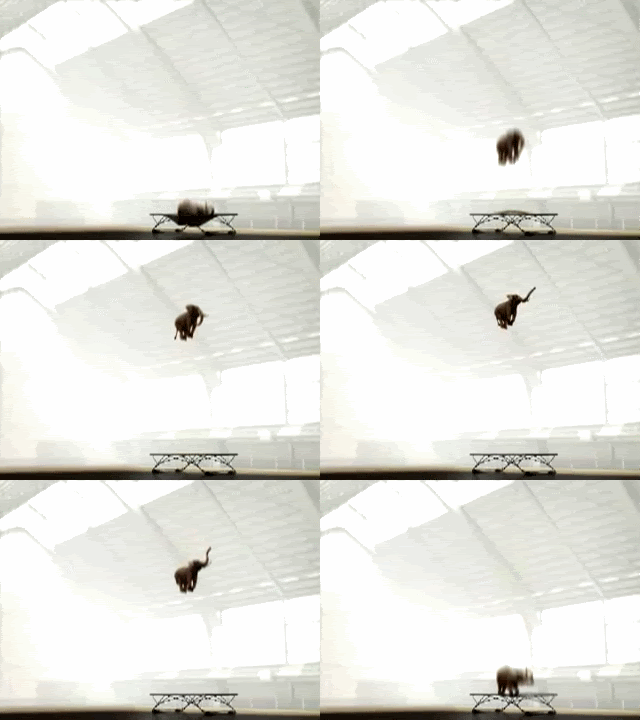
Trampolining is also a serious competitive sport in which gymnasts perform different acrobatics while jumping on trampoline. I adore the multiple exposure shots of gymnasts on trampoline which J.R.Eyerman, the photographer, made back in the 60's while working for LIFE Magazine.

© Time Inc. via images.google.com
© Time Inc. via images.google.com


If you happen to come across a trampoline these days, don't miss out on it !


Description

Wednesday, October 17, 2012

Magical Zimoun.

As I was sharing my love for kinetic art with one very special person, she introduced Zimoun to me. I became completely enchanted by his work and so I felt the need to further share the discovery.


Zimoun is an artist from Switzerland. He uses very simple elements such as cardboard, plastic bags, motors, cotton balls etc. to create intelligent and graceful sound sculptures. His minimalistic constructions, chaotic and perfectly ordered at the same time, produce monotone, yet impressively harmonious noise.


His work is reduced and abstract but still has the power to surprise. Each installation develops its own behavior through sound and motion so it resembles a live creature.


You may want to check more on Zimoun here.


Saturday, September 29, 2012

Bulbs.


Yasutoki Kariya, an art student from Japan who has been nominated for Mitsubishi Junior Designer Award 2012, has found a beautiful way to present Newton's third law of motion using bulbs. 
In a playful visual way, the installation represents the transfer of kinetic energy but instead of the swinging spheres of Newton's cradle, 11 computer programmed light bulbs are hanging from the strings . The installation is entitled Asobi which means "play".

Description

From this minimalistic bulb installation to another , as equally impressive, but less minimalistic... 


Photos via Incandescent Cloud

CLOUD is an interactive installation created by Caitlind Brown for Nuit Blanche, an arts festival in Calgary, Canada. The festival was held on the 15th of September, lasted for one night only and the visitors had a chance to interact with the CLOUD by pulling strings attached to over 6 000 bulbs, turning the lights on and off, thus illuminating and darkening parts of the cloud. 

Now be patient and have a look at the hypnotic Ballet of the Bulbs: